
Midland Previous Residents Sources by Era
Every era of Midland records leaves a different kind of trail. Work backward from the current parcel and the latest deed. Then keep stepping through the Register of Deeds index. Each layer answers a different question about a Midland address. Directories, censuses, newspapers, maps, permits, cemetery material, and probate records supply the household and place detail. A deed alone cannot give that detail. Title and occupancy are two separate facts in a residents directory search. A name on a deed may never have lived there. A name printed in a city directory may never have owned the place.
| Source | Years It Covers | Where Held | What It Shows |
|---|---|---|---|
| Register of Deeds books and index | 1855 to present | Midland County office | Parties, document type, legal description, and recording reference |
| Computer deed index and images | Index 1968 to present; online images roughly through 1950 | Fidlar and county office | Title documents and searchable recording trail |
| Older deed indexes | Pre-1958 Simple Search; 1958 to 1968 Adobe index | County links and office | Bridge before the computer index |
| Midland directories | 1897, 1929, and selected 1931 to 1960 years | MIGenWeb and Dow Library | Dated household and address snapshots |
| Census records | Federal through 1950; county material 1850 to 1894 | Library, FamilySearch, and National Archives | Household composition and enumeration date |
| Sanborn maps and permits | 1909 and January 1931 maps; permit archive start not located | Digital repositories, MCHS, City Building Department | Building, lot, address, and project clues |
A recent change calls for the parcel card and the current title record. An early house works the other way. Start from the legal description and deed books. Then pair the deed date with the closest directory, map, or census to trace past residents of Midland. The county's separate index layers are not a dead end. They tell you which counter or format to use whenever an online resident lookup stalls.
Normalize a Midland Address Before Looking Back
Normalize the address first. Midland County runs house numbers as a public-safety, postal, and emergency-response system. Deeds rest on a legal description, parcel number, lot, block, or subdivision. Search the BS&A property and tax search by address to pull the situs address, owner mailing address, parcel number, legal description, and sale clues. A mailing address and a physical address can differ. Copy both, and treat neither as the whole record.
Then match the parcel in Midland County FetchGIS. Check it against the county's house-numbering information. Uniform numbers serve police, fire, EMS, postal officials, and residents. No citywide renumbering date exists to explain an old mismatch. When a modern number fails to surface in an older street directory, keep the abbreviated street spelling. Work from the plat, legal description, historic district lot and block data, or parcel boundary rather than guessing.
Address flow: modern street address → BS&A parcel and legal description → FetchGIS parcel check → Register of Deeds recording reference → older map or directory spelling.
Note: A matching street address helps, but the legal description is the safer bridge when lots or street forms have changed.
Midland Previous Residents and Deed-Index Eras
Midland County land records reach from 1855 to the present. But the access route shifts by era. The Register of Deeds describes old books and microfilm. It also lists a pre-1958 Simple Search, a 1958 to 1968 Adobe-search index, and scanned or indexed computer records from 1968 on. The county FAQ describes online index and copy access from 1949 forward. Online images run through roughly 1950. Those statements cover different layers of the same archive. Verify the live Fidlar result. Contact the office when the record you want is missing online.
The Register of Deeds FAQ walks through the grantor and grantee method. It also covers the office's books and microfilm. The current Fidlar destination can shift. The county has warned users to refresh saved land-record links. The comparison is simple. Online access speeds a recent search; the counter collection reaches further back. Neither replaces the other in a thorough Midland residents directory trace.
Copies carry a $1 per-page charge, a $5 recorded-document certification charge, and $1 per page after certification. Those figures apply to recorded-document copies only, not every service. Confirm current totals with the office before sending payment.
Trace Midland Previous Residents Through Deed Chains
A deed chain links one title transfer to the next through the parcel's legal description. Start with today's owner on the assessment record. In the Register of Deeds index, that owner usually appears as grantee on the acquisition deed. The seller named there becomes your next target. Search that name as grantee to find the earlier purchase. Check the legal description at each step. Note the parcel boundary, recording reference, and the document type as well. Names alone can mislead. Neighbors often shared surnames, or one party held several Midland parcels.
- Search the address in BS&A and record the owner, parcel number, situs and mailing address, legal description, subdivision, lot, block, and sale clues.
- Use the current owner as grantee in Fidlar Tapestry to locate the purchase deed and identify its grantor.
- Search that grantor as grantee to find the earlier acquisition, then compare the legal description before accepting the match.
- Repeat the transfer sequence and note the instrument type, recording date, liber or book and page, document reference, and any image access.
- Move to Simple Search, the Adobe index, office books, or microfilm when the online route reaches an earlier index boundary.
- Grantor and grantee
- The grantor transfers an interest; the grantee receives it. In a backward title search, the prior seller is often searched as a grantee for an earlier purchase.
- Chain of title
- The ordered series of transfers for the same parcel, checked by legal description rather than by a street address alone.
- Legal description
- The lot, block, subdivision, metes, or other recorded land wording that identifies the property in a deed.
A deed proves only that ownership changed hands on a recorded date. It never lists every person who actually lived in the Midland home. Past residents surface instead through a dated street directory, a census entry, or a local notice that captures the household.
Midland Sanborn Maps and Permit Clues
Maps and permits can pin the physical place to a moment between title transfers. Midland has two useful map items. There is a 1909 Sanborn set and a digitized January 1931 sheet. A fire-insurance map shows the building footprint, lot context, street form, and use at the map date. It is not a roster of people. The City Building Department's application collects a project address, owner, contractor or architect, project description, value, and construction details. The department offers no public permit-history search online. Ask the office directly, or file a city FOIA request for older material.
The digitized January 1931 Midland Sanborn map anchors a structure to a single year. It can reveal a street form or lot layout that differs from today's. Those details carry straight into the deed search at the records office.
A house-history timeline holds up best when three dates agree. Line up the Sanborn map date, the deed transfer date, and the directory date for the same address. When all three lean the same way, the story of who lived there gets much firmer. A single map label should still be weighed carefully against the rest.
Note: A permit applicant or map label is a place clue, not proof of an entire household at the address.
Midland Previous Residents With Old Street Forms
Old street shorthand in Midland records can hide an address from a modern search. The 1929 directory abbreviates heavily. It prints Ashmn for Ashman, Ellis for Ellsworth, and Butt for Buttles. Eastmn stands for Eastman Road, Posey for Poseyville Road, and Tittab for Tittabawassee. Read a printed "Carp." in context before matching it to a current street. Search both the short and full forms in newspapers, directory scans, deeds, and maps.
When an address refuses to appear under its current number, two tools help. West Main Street Historic District material often preserves the older identifiers. Original-plat lot and block descriptions often do too. The discipline that matters is documenting the connection itself. Never assign a former street name or a renumbering year without a source behind it. No citywide renumbering event is on record for Midland. An assumed conversion is therefore never justified.
Pair Midland Directories, Census, and Previous Residents
A name in a title answers only half the past-resident question. Midland's 1897 Official Register and 1929 directory offer dated address snapshots. So do the 1931 through 1960 books now on the shelf. Some volumes carry a reverse or criss-cross section. It lets you browse by street. Midland directories do not all include one. Only the alphabetical part of a book may survive. Use the name entry as your confirmation in that case. The Midland city directories collection supplies the detailed shelf and entry guidance.
Federal census records open to the public through 1950 under the 72-year rule. Midland County material includes 1850 through 1894 federal microfilm plus an 1894 state census. Pairing works best as a date sequence. Treat a directory as a snapshot, never as a legal residence record.
- Set the deed transfer date beside the closest located directory year.
- Copy the surname, address, spouse or child notation, and every street abbreviation from the directory.
- Compare the closest census household, enumeration date, and address information.
- Use a newspaper notice or obituary only after the name and address are tied to the correct period.
- Keep a separate column for title holder, printed household, and unresolved names.
A disappearance from the records can mean several things. It might mark a move, a death, a missing volume, or simply a changed spelling. That makes it a reason to compare another source, not a conclusion on its own.
Midland Previous Residents at Trail Endpoints
Obituaries, probate, and cemetery records can close an address trail or extend it. The Library of Michigan Midland County guide gathers county-level census, newspaper, cemetery, plat, and archival pointers. Those pointers can support a hard address trail for past residents of Midland. The Library of Michigan guide lists obituary indexes covering 1872 to 1927 and 1951 to 1982. It also notes a 2004 two-volume publication. Midland Municipal Cemetery material reaches back into the late 1800s. The current cemetery site has been in use since 1873. The City Clerk is the contact route. The cemetery offers no public online interment-name search. Probate files can name an estate representative or heirs. Read them as legal records rather than shortcuts to personal details.
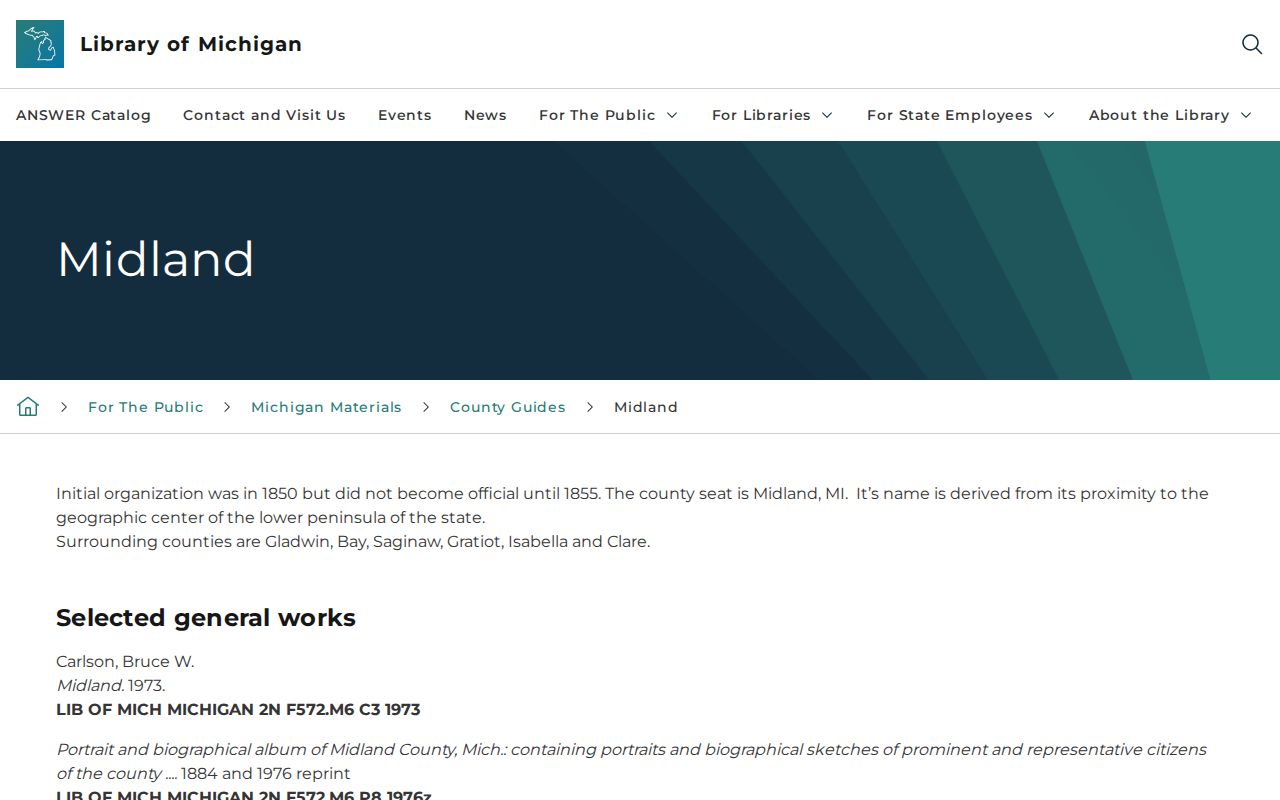
Use that guide to pick the next custodian whenever a deed, directory, or map leaves a gap. Grace A. Dow Library, the City Clerk, the Probate Court, the Register of Deeds, and MCHS each hold a different piece of the local record story.
Midland Previous Residents and Personal Use
A past-resident search fits many honest purposes. House history, family history, estate or heir research, and ordinary neighborhood curiosity all qualify. Keep the focus on records and dates. Michigan's Address Confidentiality Program offers a designated-address option for qualifying survivors and for people at increased risk of physical harm. Some address information is properly withheld as a result. Never try to overcome a protected address by cross-checking public sources.
Lawful use. Use Midland address history for personal, lawful research. Michigan's anti-stalking law, MCL 750.411h, prohibits conduct that tracks or harasses another person.
When the record stays unclear, preserve the uncertainty. Ask the named custodian about access rules instead of guessing. A careful gap serves you better than a confident household claim with nothing behind it.